The degradation of toil
Martin EdenThe degradation of toil describes what happens to Martin Eden when work ceases to be merely strenuous and begins to occupy the whole field of consciousness. At Shelly Hot Springs, the laundry’s pace, heat, and unrelenting demands turn him from a self-educating aspiring writer into what he recognizes as a work-beast. The concept’s force lies in this reversal: labor that is often praised as healthy and character-building instead strips away thought, beauty, and the capacity to pursue a life beyond the next task.
The Work Process and Its Pace
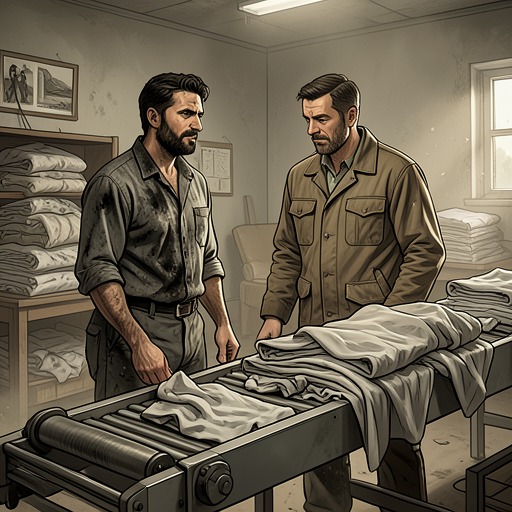
Martin enters the laundry without experience, but quickly learns its procedures alongside Joe Dawson. Their work is organized around speed and the elimination of wasted movement. Joe demonstrates how a task can be completed in fewer motions; Martin watches, imitates, and takes pride in matching his partner’s quickness. They starch two hundred white shirts, rubbing starch from the collars and cuffs before ironing, and move through jobs without waiting for the next one to arrive. The skill is real, but it is harnessed to a rhythm that leaves little room for anything outside production.
The ironing makes that rhythm visible in the body. Joe operates the tiler, a machine that presses a hot iron against parts of the shirt; Martin catches each finished shirt and irons the unstarched portions. They work hour after hour in a room made hotter by a roaring stove and the steam rising from damp cloth. Their judgment must be precise: they assess an iron’s temperature by holding it near the cheek, and cool an overly hot iron by dipping it into water, taking care not to leave it there long enough to lose its proper heat. Martin develops an almost automatic accuracy, yet even this accomplishment belongs to the work’s demands. The shirts must be finished quickly, smoothly, and without rumpling for hotel guests relaxing on the verandas.
The schedule intensifies as the hotel fills. “Fancy starch” brings more work; the men labor late under electric lights, bolt their meals, and sometimes begin again before breakfast. Joe counts and guards each available moment, while Martin follows the same driving pace. On one occasion, a casual remark from Joe interrupts Martin’s concentration and costs him a stroke and two extra motions. Conversation itself becomes a liability. The work does not simply take time from other activities: it trains attention to treat anything beyond the task as an interruption.
The Narrowing of Mind and Self
The novel renders this narrowing as a closure of Martin’s inner life. His consciousness contracts to the movements of his arms, shoulders, fingers, and iron; his mind’s wider “corridors” are shut while he directs each stroke across shirts and sleeves. The image of the intelligent machine captures the contradiction: Martin’s practiced intelligence remains active, but it is confined to serving the labor process. There is no mental space left for the universe and its problems, or for the identity he had formed through reading and writing.
The change reaches into his personal attachments. The narrator describes Martin as unable, during the workday, even to know that he loves Ruth Morse: she disappears from his awareness until brief memories surface at bedtime or breakfast. He sweats through the heat and drinks great quantities of water, yet the exertion continues to consume him. At sea, his work had left him opportunities to commune with himself; in the laundry, the hotel manager seems to command not only his time but his thoughts. This contrast makes the injury more than physical fatigue. Martin’s former work allowed an inward life alongside duty; the laundry’s demands crowd that life out.
On Sundays, the effects persist after the machines and irons have stopped. Martin sleeps in the shade, reads a newspaper without purpose, and lies doing nothing because he is too dazed to think. He feels repelled by himself, as though something in him has been degraded. Ambition loses its force; sunlight and the sky no longer open onto beauty or cosmic possibility. His inner vision is darkened, and life tastes dull and bad. The language of spiritual death and animal existence gives the title concept its sharpest expression: the worker remains alive and productive, but experiences himself as reduced to a beast of toil.
Exhaustion, Escape, and Drink
The weekly pattern offers only a brief interval of release. When Saturday work ends at three, Joe goes to the village to drink and forget the coming week. Martin initially uses his bicycle differently: he oils the chain, adjusts the bearings, and rides seventy miles to Oakland, then covers the same distance back on Sunday. The journey preserves a remnant of his former vitality, but it is not restorative. After the fifth and sixth weeks, the hundred-and-forty-mile round trip feels like another superhuman exertion, one that helps crush the last glimmer of a self beyond work.
After seven weeks, Martin follows Joe to the village and drinks. Three months into the job, he does so again, and the episode brings a moment of recognition. He sees that the work, not the drink, has been making a beast of him. Alcohol has become an effect of labor’s deadening pressure: it briefly allows him to forget and feel alive, but it does not explain the condition that makes escape necessary. The distinction matters because it reverses the easy moral diagnosis. The bottle is not presented as the original cause of Martin’s decline; the work has already worn down the vitality that drink temporarily obscures.
Refusal and the Meaning of Toil
Martin does not conclude that all effort is harmful. When Ruth recoils from the physical intimacy he has shown her, he bitterly answers that she has never known anyone who worked in the laundry at Shelly Hot Springs. He acknowledges the conventional claim that toil is necessary for health and insists that he has never feared it, but adds that too much of a good thing can become destructive. The laundry experience has made him resolve to go to sea for one more voyage, which he believes will be his last before he breaks into the magazines.
The promise to write about “The Degradation of Toil” or the “Psychology of Drink in the Working-class” turns lived exhaustion into a prospective subject for thought and writing. That intention stands against the very condition he describes: while the laundry has occupied his mind, he could scarcely reflect on what it was doing to him; only a break in the cycle allows him to name the relation between overwork and drinking. Ruth remains unsympathetic, and Martin recognizes that she cannot understand what he has undergone. The concept therefore joins bodily experience to a failure of communication: the damage is legible to the person who endured it, but not readily understood from outside the laboring life.
Narrative Significance
The laundry episodes test Martin’s belief that discipline and effort can carry him toward intellectual and literary achievement. His speed and growing technical precision demonstrate ability, but the work offers no corresponding expansion of freedom or inner life. Instead, the more completely he gives himself to its pace, the less access he has to the reading, ambition, and aesthetic perception that define his larger aims. The contrast exposes the difference between skill and self-realization: efficiency at a task does not guarantee that the worker retains the time or mental independence to become more than the task requires.
The recurring figure of the machine makes this conflict concrete. Martin first learns to work with near-mechanical accuracy; later, he imagines himself as a machine with only a spark of something more left inside. His cycling, drinking, and eventual diagnosis of the problem are different responses to an existence narrowed by labor. Together they show why the degradation is not simply tiredness after a hard day. It is a progressive loss of the capacities that make a life feel one’s own, and a warning that toil praised in the abstract can become destructive when its pace leaves no room for thought, rest, or independent purpose.